


Helping Children Find and Celebrate Their Creative Element

Updated: Apr 23
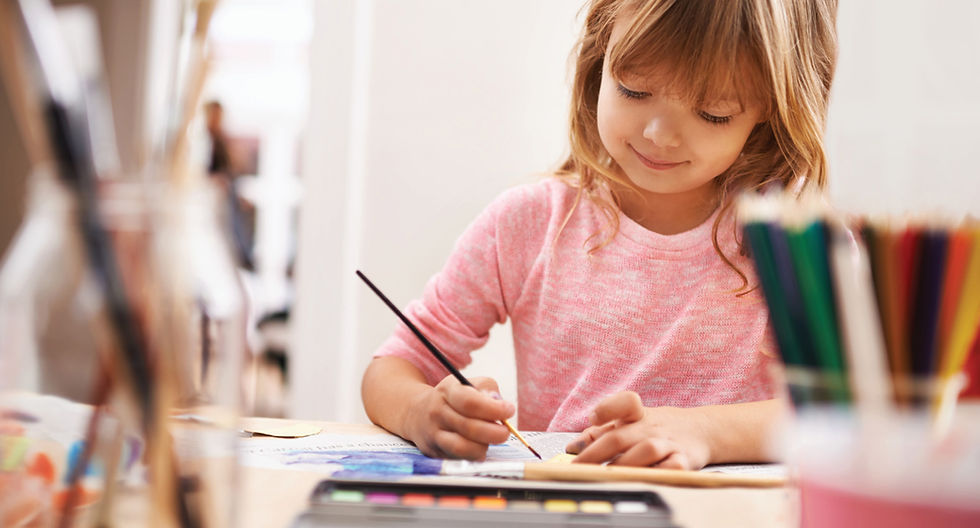
Young children have a wonderful way of thinking about the world, and they explore their thinking with creative abandon. Why is it so common, then, for people to lose their curiosity and creativity as they grow up? In this post, we’ll explore the power of the arts and the art of making mistakes, and we’ll also celebrate the late great Sir Ken Robinson, who encouraged people to find their unique creative “element.”
Sir Ken Robinson, the British author and renowned expert on education, loved to tell stories that honored children’s creativity. One of his favorites was about a six-year-old girl who sat in the back of an art class, hunched over a piece of paper and drawing intently. The teacher went to ask the girl what she was drawing, and without looking up, the girl replied, “I’m drawing a picture of God.” Surprised, the teacher said, “But nobody knows what God looks like.” And without hesitation, the girl replied, “They will in a minute!”
Robinson included this anecdote in the introduction to his inspirational book The Element: How Finding Your Passion Changes Everything to illustrate how young children are “wonderfully confident in their own imagination.” But the author went on to say that while we’re born with natural curiosities, unique capacities, and creative confidence, we often “lose touch with many of them as we spend more time in the world.” And this loss leads to a significant and critical loss of awareness. “Too many people,” Robinson wrote, “never connect with their true talents and therefore don’t know what they are capable of achieving.” And a person’s true talents and capacities are what Robinson referred to as their Element.
Robinson says the key to personalizing education is to “build achievement on discovering the individual talents of each child, to put students in an environment where they want to learn and where they can naturally discover their true passions.”
— Ken Robinson, The Element: How Finding Your Passion Changes Everything
While Robinson described many reasons for this decline in creative confidence and these missed opportunities for finding our Element, here are three key points in his argument.
We often educate creativity out of children rather than highlighting it in their education.
A great focus of education is on acquiring facts, information, and knowledge—which are indeed important. But there must also be balance of opportunities for exploration, creative thinking, and self-expression without limitations on having only “right” answers. Indeed, the teacher telling the young artist that no one knew what God looks like is an example of how parents and other educators can set a child up to doubt their abilities and stop exploring their creative capacities.
We connect mistakes with not learning, rather than as essential to learning.
Making mistakes is a crucial part of the creative process because it encourages learning, drives innovation, and builds resilience. An error or mistake provides valuable feedback because when one path fails, the creator is pushed to pivot or adapt to try a new approach. Too often, children are in environments where mistakes are seen as failures, not opportunities—so they learn to take fewer risks, which keeps them in a smaller comfort zone.
We see the arts as extra subjects rather than essential components of an education.
Robinson was a passionate advocate of the arts and pointed to the value of integrating art, music, drama, and movement into everyday learning. Robinson certainly didn’t propose that we should all become artists, of course. But he held the arts up as supreme models for creative thinking, and in turn, he celebrated creativity as a fundamental aspect of intelligence.
So how can parents and educators support children to find their Elements and stay creative?
In addition to helping children acquire facts and knowledge, provide opportunities for experimentation and exploration of unique subjects. How students go about processing and understanding these subjects reveals a great deal about their interests and passions.
Help children see the value of their “mistakes” by presenting them with challenges and modeling an open mindset. Share the message that mistakes and errors aren’t reasons to stop learning. In fact, they’re opportunities to learn more.
Normalize the arts—in all of their forms—as an essential part of learning. And if you encourage them to pay attention to the process of creating, they’ll come to see how they can transfer that process to other areas of their learning.
By helping students explore their passions and strengths, we can foster lifelong learners who are curious, confident, and creative, and who are capable of finding their Element!
Other resources:
Ken Robinson, The Element: How Finding Your Passion Changes Everything. Penguin Books, 2009.
Ken Robinson, “Do Schools Kill Creativity?” TED Talk, February, 2006. https://www.ted.com/talks/sir_ken_robinson_do_schools_kill_creativity
Ken Robinson, Out of Our Minds: The Power of Being Creative, Capstone, 2017.
Ken Robinson’s “Element” and the Artifact Creative curriculum:
The team at Artifact Creative thinks our approach to teaching the arts and humanities would make the late Sir Ken Robinson proud. First, our lessons, materials, and activities are designed to promote exploration, creative thinking, and self-expression. Second, our material celebrates the value of the creative process and promotes the message that making mistakes and taking risks are essential to learning. And third, we view creativity as a fundamental—and joyous—aspect of intelligence. Robinson did not advocate the idea that everyone should become a practicing artist, and neither do we. But our curriculum centers on the creative, personalized, and meaningful learning that Robinson valued most.
About the author:
Carrie Kennedy spent almost two decades in classrooms—including teaching art, English, and science— and now serves as the Director of Curriculum Content and Development at Artifact Creative. Kennedy is the author of four books and has written and lectured extensively on the subject of creativity and learning.
When students study subjects like music, visual art, theater, literature, dance, creative writing, and history, they learn to make meaningful connections to their own lives and to the world around them. Artifact Creative develops digital and hands-on educational material in these rich areas of the arts and humanities to inspire critical, creative, and compassionate thinking and to serve as an essential foundation for authentic, lifelong learning.
For more information, visit ArtiFactCreative.org or contact Dana.Corradi@ArtiFactCreative.org
© 2026 Artifact Creative. All rights reserved. Artifact Creative is a service of the Lincoln Park Performing Arts Center


